
Iran's Revenge, TNI Soldiers Wounded in Lebanon, and Global Fears of World War III: A Situation Report as of April 4, 2026
A comprehensive analysis of the escalating multi-front conflict—from Hormuz to Beirut—and the widening human and economic toll on Asia.
TEHRAN / JAKARTA / NEW YORK – As the calendar turns to April 4, 2026, the Middle East conflict has transformed into a multi-front war showing no signs of abating. What began five weeks ago as precision U.S.-Israeli strikes on Iranian military infrastructure has now metastasized into a regional conflagration. Iran has launched direct retaliatory strikes on Israeli territory and U.S. commercial assets across the Gulf, while the conflict has claimed new and unexpected casualties: Indonesian peacekeepers serving with the UN in southern Lebanon.
The situation has become so dire that prominent economists and geopolitical analysts are openly warning that the world may be witnessing the early stages of World War III. Asia Economia Times synthesizes the latest developments, casualty reports, and diplomatic deadlock to provide a clear picture of a conflict spinning dangerously out of control.
Iran’s Revenge Campaign: Missiles on Tel Aviv and a Hunt for U.S. Pilots
Iran has followed through on its promise of "severe revenge." On April 3 and 4, the Israeli military reported detecting and intercepting multiple waves of missiles fired directly from Iranian territory. Air raid sirens sounded across central and southern Israel, with one confirmed injury in the city of Bnei Brak from shrapnel caused by an intercepted missile or falling debris.
Most dramatically, the Iranian military claims to have shot down two U.S. military aircraft over the Gulf. U.S. officials confirmed that one F-15-E Strike Eagle fighter jet went down, with one service member rescued and at least one other missing. Iranian state media also claimed to have downed a U.S. A-10 attack aircraft, broadcasting images of what it said were wreckage in the country's rugged southwest and even deploying forces to hunt for surviving crew members. This marks the first time a U.S. military aircraft has been shot down by enemy fire in over two decades.
On the ground, the U.S. death toll since the conflict began has risen to 13 military personnel, with 247 wounded—the majority being mid-to-senior level Army enlisted troops. The White House confirmed that President Trump has been briefed on the downed jet and ongoing rescue operations.
Economic Warfare: Oracle, Amazon, and Oil Facilities Targeted
Iran's revenge is not limited to military targets. It has explicitly shifted to economic warfare, targeting U.S. commercial assets across the Gulf. Iran’s Revolutionary Guard previously threatened to attack 18 U.S. companies, including tech giants Oracle and Amazon, accusing them of engaging in "terrorist espionage."
That threat has materialized. In Dubai, authorities confirmed that the façade of a building housing U.S. tech company Oracle was damaged by debris from an intercepted drone. This follows earlier Iranian strikes that damaged three Amazon Web Services facilities in the UAE and Bahrain. Further south, a fire at a gas complex in Abu Dhabi, caused by falling debris from an intercepted attack, killed one Egyptian national and injured four others. Even Iraq has not been spared, with a drone strike causing a fire at a storage facility owned by a foreign oil company west of Basra.
The strategy is clear: by striking U.S. commercial assets in allied Gulf states, Iran aims to drive a wedge between Washington and its regional partners, raising the economic cost of hosting American businesses and military bases.
The TNI Tragedy: Three Indonesian Peacekeepers Wounded in Lebanon
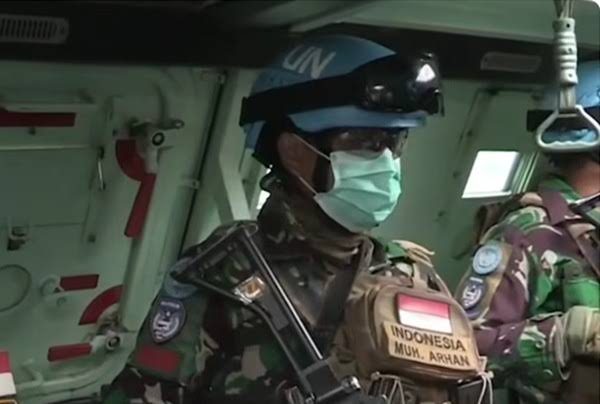
Amid the superpower confrontation, the human cost has spread to unexpected corners. The United Nations Interim Force in Lebanon (UNIFIL) confirmed that three Indonesian National Army (TNI) peacekeepers were wounded in an explosion inside a UN facility near El Adeisse in southern Lebanon on Friday, April 3. Two of them are reportedly seriously injured.
The incident marks the third attack on UNIFIL personnel in less than a week. Just days earlier, three other Indonesian peacekeepers were killed in two separate explosions, with their bodies repatriated to Jakarta on April 4.
The source of the latest explosion remains disputed. While UNIFIL spokesperson Kandice Ardiel stated that "we do not yet know the origin of the blast," the Israel Defense Forces (IDF) has pointed the finger at Hezbollah. The IDF released a statement and map claiming that trajectory analysis "clearly indicates that the firing was carried out by the Hezbollah terrorist organization." Regardless of the perpetrator, Indonesian peacekeepers find themselves caught in the crossfire of a conflict not of their making, underscoring the expanding geographic and human footprint of the war.
World War III Warnings: The Strait of Hormuz and Failing Diplomacy
As fighting intensifies, so do the warnings. Prominent economist Jeffrey Sachs, an advocate for the UN’s Sustainable Development Goals, warned in a late March interview with Nikkei Asia that if the current trajectory continues, the conflict "could easily turn into a global conflagration, effectively becoming World War III."
The primary concern remains the Strait of Hormuz, through which approximately one-fifth of the world’s oil and 30% of its LNG pass. Iran has effectively choked the strait, and while a handful of tankers are risking hugging the Omani coast to transit, normal commercial shipping has ground to a halt. The economic shockwaves are already being felt globally, with Pakistan slashing petrol prices by PKR 80 per liter just days after a steep hike, illustrating the extreme volatility in energy markets.
Diplomatic efforts to halt the descent have failed. Iran has formally rejected a 48-hour ceasefire proposal from the United States, delivered through a third country, calling the U.S. demands "unacceptable." Pakistan-led mediation efforts are reportedly stalled, even as Islamabad denies reports of a collapse. The UN Security Council has delayed a vote on a Bahraini resolution to protect Hormuz shipping, facing opposition from China over authorization of force.
Conclusion: No Exit in Sight
As of April 4, 2026, there is no diplomatic exit in sight. The U.S. and Israel continue to strike Iranian military and nuclear infrastructure, with the IDF announcing fresh strikes on ballistic missile storage sites in Tehran on April 3. Iran continues its barrage of missile and drone attacks, targeting not only Israel but also the economic foundations of America’s Gulf allies. And caught in the middle are peacekeepers like the three wounded TNI soldiers in Lebanon—a stark reminder that in modern warfare, no one is truly insulated.
Asia Economia Times will continue to monitor the fate of the Indonesian peacekeepers, the search for the missing U.S. pilot, and the next steps in a war that is increasingly fitting the definition of a global, not regional, conflict.
Reference & Metadata
Title: Iran’s Revenge, Wounded TNI Soldiers in Lebanon, and Global World War III Fears: Situation Report as of April 4, 2026
Excerpt: A comprehensive Asia Economia Times analysis by M. Rizqie Priyadi on the escalating multi-front conflict as of April 4, 2026, covering the Iranian downing of a U.S. jet, retaliatory strikes on Oracle facilities in Dubai, the wounding of three Indonesian TNI peacekeepers in Lebanon, and stark World War III warnings from economist Jeffrey Sachs.